
Beyond Conservation: Mastering Water Efficiency for Today’s Buildings
Water efficiency is no longer just about saving water. It is about reducing operating costs, controlling utility bills and getting more value from every litre a building consumes.
For years, building water management was treated mainly as an environmental responsibility. Facility teams were encouraged to reduce consumption, fix leaks and promote responsible use. Today, the conversation is becoming much more practical. Every litre entering a building has a cost attached to it. The building pays to source or purchase the water. It may pay to pump it, heat it, treat it and distribute it. Once used, it becomes wastewater that also needs to be collected, treated and discharged. When water is wasted, several operating costs can increase at the same time. That is why modern water efficiency should be viewed as an operational and financial strategy, not simply a conservation exercise.

Water Bills Tell Only Part of the Story
A facility manager looking at the monthly water bill sees only one part of the cost. Consider a commercial building with high restroom usage. Every flush consumes water. That water has already been purchased, pumped and distributed before it reaches the urinal or toilet. After flushing, the building also has to deal with the resulting wastewater. This creates what can be called the full water cost: Water supply + pumping + heating/treatment + wastewater + maintenance = actual water-related operating cost. A reduction in consumption therefore has the potential to influence more than the water meter. For large buildings, even small reductions repeated thousands of times can create measurable savings over an entire year.
Start With Where the Water Goes
The first step toward better water efficiency is understanding consumption. A building does not waste water in one dramatic event. Most of the time, consumption is distributed across hundredsof small activities. Restrooms, cooling systems,kitchens,landscaping,housekeeping, domestic use and process operations can all contribute to the total. Facility teams should therefore create a basic water-use profile.
How much water enters the building every month?
Where is it being consumed?
Which areas have the highest usage?
Which fixtures operate continuously?
Where do leaks occur?
Which water uses require potable water and which could use treated or recycled water?
Without this baseline, efficiency projects often become guesswork. With it, facility managers can identify where the largest opportunities actually exist.
The ROI of Water Efficiency Starts With Measurement
A water-saving project should not begin with the question, "How much water will this save?"
It should begin with:How much does this water currently cost us?Suppose a building uses 10,00,000 litres of water every month. If a particular intervention reduces consumption by 10%, the saving is 1,00,000 litres per month or 12,00,000 litres annually. The financial value depends on the building's actual water procurement and wastewater costs. This is why two buildings with identical fixtures can have completely different project economics. A facility receiving relatively inexpensive municipal water may have a different payback period from a facility that depends heavily on purchased tanker water. The same applies to waste water. Where sewage treatment, pumping or tanker disposal costs are significant, reducing unnecessary water entering the drainage system can create additional financial value.
Think in Terms of Payback, Not Just Purchase Price
One of the biggest mistakes in facility procurement is comparing products only by their initial cost. A ₹5,000 fixture and a ₹10,000 fixture may look very different on a purchase order. But if the more expensive option reduces recurring water and maintenance costs, the initial price difference may become much less important over its operating life. A simple ROI calculation can help:Annual savings = water savings + wastewater savings + other measurable operating savings Payback period = initial investment ÷ annual savings
For example, if a project costs ₹2 lakh and generates ₹1 lakh in measurable annual savings, its simple payback period is approximately two years. The actual calculation should include installation costs, maintenance, expected equipment life and any changes in utility pricing.
The objective is to move the discussion from "What does this cost?" to "What does this cost to operate over time?"
Restrooms Are an Easy Place to Find Recurring Savings
Commercial restrooms offer a particularly useful starting point because usage is repetitive. A fixture may operate hundreds or thousands of times without anyone consciously deciding to consume water. Urinals are a good example. A conventional flush urinal uses water every time it is flushed. In a high-footfall building, those individual flushes accumulate into a significant annual volume. Waterless urinals remove flushing water from that equation.

Zerodor: Reducing Water Use at the Fixture
Zerodor by Ekam Eco Solutions is designed to eliminate the need for flushing water in men's urinals. Instead of using a conventional flush cycle, Zerodor uses a mechanical one-way valve that allows urine to pass into the drainage system while helping prevent sewer gases and odour from travelling back into the restroom. This means the water saving happens directly at the point of use. Ekam Eco Solutions reports that a Zerodor installation can save 150,000+ litres of water per urinal per year, depending on usage and the conventional fixture being replaced. At that reported saving level, 10 urinals could represent approximately 1.5 million litres of avoided water consumption per year. For a large commercial campus with multiple buildings, the cumulative opportunity can become substantial. The actual ROI should always be calculated using the facility's own flush volume, daily usage, operating days, water cost and wastewater cost. That makes the business case more credible and easier for procurement and finance teams to evaluate.
Waterless Urinals Can Also Reduce Wastewater Load
Water efficiency is often measured only on the incoming side. But every litre that enters a drainage system eventually has to go somewhere. When a urinal uses flushing water, urine is mixed with additional water before entering the wastewater stream. A waterless urinal removes that flushing water from the equation. This does not eliminate the need for wastewater treatment. It reduces the volume of water associated with that particular use. For facilities operating sewage treatment plants, this can be relevant because wastewater volume affects pumping, treatment and infrastructure requirements. The financial impact will vary from building to building, but it is worth including in a complete water-efficiency assessment.

The Biggest Savings May Come From Avoiding Water Purchases
In many Indian cities, buildings do not rely on a single water source. Municipal supply may be supplemented by tankers, borewells or treated water systems. This changes the economics considerably. A building dependent on purchased tanker water can face a much higher effective cost per litre than a building receiving a relatively inexpensive municipal supply. Reducing consumption in such a facility can therefore deliver a much faster financial return. This is why water-efficiency projects should be evaluated using actual procurement costs, not generic water prices. If your building purchases water during summer shortages, that cost should be part of the calculation.
Fixing Leaks Is Still One of the Highest-Value Actions
Not every water-efficiency project needs new technology. Sometimes the biggest saving is already sitting inside the building. A leaking toilet valve, dripping tap, damaged pipe or overflowing tank can waste water continuously. Unlike a fixture that operates only when someone uses it, a leak can consume water 24 hours a day. Regular meter monitoring can help identify abnormal consumption. If overnight consumption is unusually high in a building that should have minimal activity, it may indicate leakage or another continuous-use problem.
This is where simple data becomes powerful. Measure → identify → repair → measure again. Water efficiency should be treated as an ongoing management process rather than a one-time project.
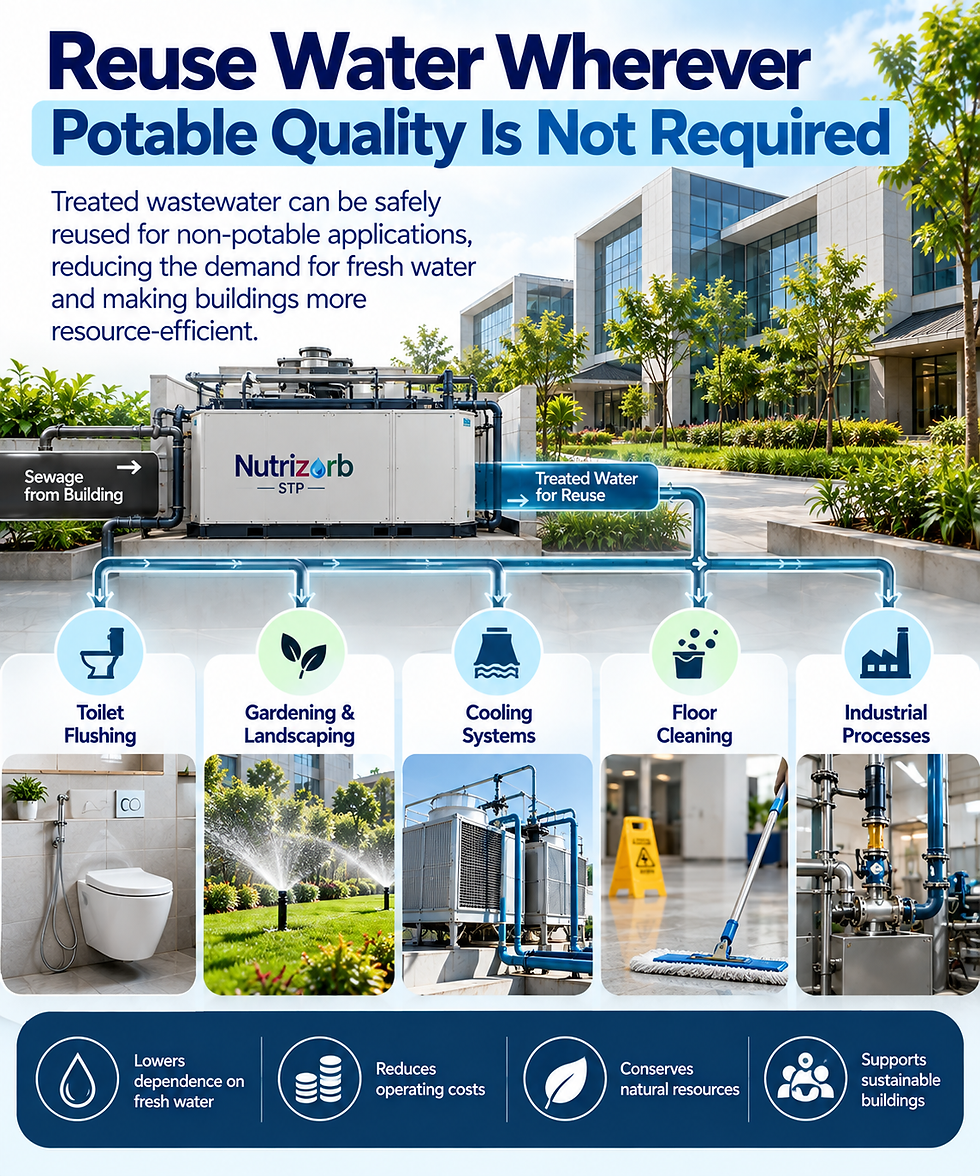
Reuse Water Wherever Potable Quality Is Not Required
Another major opportunity is matching water quality to the application. Not every building activity requires drinking-quality water. Treated wastewater or appropriately treated greywater may be suitable for applications such as toilet flushing, landscaping, cooling or other non-potable uses, subject to applicable regulations and treatment standards. This creates a different type of saving. Instead of reducing demand alone, the building can reduce its dependence on fresh potable water by creating an alternative supply for suitable applications. A strong water strategy therefore combines:Reduce → Reuse → Recycle → Replenish. The first priority should still be eliminating unnecessary consumption. Reuse and recycling then help reduce the remaining freshwater demand.
Cleaning Operations Also Influence Water Costs
Housekeeping is another area that can increase consumption. Traditional cleaning routines can involve excessive water use, repeated rinsing and unnecessary wet cleaning. Standardising cleaning procedures can help reduce this. The objective is not to compromise hygiene. It is to make sure every cleaning task uses the amount of water actually required. The same principle applies to chemical cleaning. Using concentrated or bio-based products according to manufacturer instructions can reduce unnecessary product consumption while supporting more controlled cleaning practices. Water efficiency works best when it becomes part of the building's operating culture rather than a separate sustainability programme.
Don't Forget Energy
Water and energy are connected. Water may need to be pumped from underground tanks to upper floors. It may need to be heated for washrooms or kitchens. Wastewater may need to be pumped and treated. Every unnecessary litre can therefore carry an energy requirement. Reducing water consumption can help reduce some of the energy associated with pumping, heating and treatment. This is particularly relevant for large buildings where water moves through multiple stages before and after use. A facility that tracks water and energy separately may miss this connection. A better approach is to consider the water-energy relationship when evaluating major efficiency projects.
Build a Water Efficiency Dashboard
Once a facility begins measuring water consumption, the next step is to make the information visible.
A practical dashboard can track:
Total monthly water consumption
Water consumption per occupant
Water consumption per square metre
Tanker water purchased
Municipal water consumption
STP treated-water volume
Recycled-water usage
Major leak incidents
Restroom water consumption
Cost per kilolitre
Total monthly water-related expenditure
This creates a much clearer picture than looking at the water bill once a month. It also allows facility teams to identify trends. If consumption suddenly increases, the team can investigate.
If a water-saving project is installed, the dashboard can demonstrate whether consumption actually changes.
Water Efficiency Needs Finance and Facilities at the Same Table
Water projects are sometimes treated as sustainability initiatives that belong exclusively to the ESG team. That approach can limit their impact. The facility manager understands the operational problem. The finance team understands the cost. The sustainability team understands the environmental target. Procurement understands the vendor and lifecycle implications. Bringing these perspectives together makes the business case stronger. Once those numbers are clear, the environmental benefit becomes an additional value rather than the only justification.

The Future of Building Water Management Is Financially Intelligent
The next generation of water-efficient buildings will not simply consume less water.They will understand where every major litre goes and what that litre costs. That means identifying leaks before they become large losses, replacing inefficient fixtures, reducing unnecessary flushing, increasing appropriate water reuse and continuously monitoring consumption. For a facility manager, water efficiency is ultimately about control. Control over consumption. Control over operating costs. Control over utility bills. And control over the resources that keep the building running. Solutions such as Zerodor demonstrate how a relatively small fixture-level change can become part of a larger commercial water strategy. When combined with leak management, efficient fixtures, water reuse, STP optimisation and continuous monitoring, these interventions can turn water management from a monthly utility expense into a measurable efficiency programme. The goal is not simply to use less water. The goal is to make every litre work harder for the building.


Comments