
Retrofitting vs New-Build: The Most Cost-Effective Path to Green Certification for Existing Commercial Properties
Existing Buildings Hold the Biggest Sustainability Opportunity
India's commercial real estate sector is rapidly embracing sustainability. Developers, investors, and corporate occupiers are increasingly looking for buildings that consume less water, use less energy, and comply with evolving ESG expectations. While many assume achieving these goals requires constructing new green buildings, the reality is quite different. Most commercial properties can achieve significant sustainability improvements through strategic retrofitting rather than complete redevelopment. Offices, malls, airports, educational institutions, hospitals, hotels, manufacturing facilities, and IT parks can improve resource efficiency while continuing normal operations. A retrofit green building in India often delivers environmental and financial benefits much faster than starting construction from scratch.

Why Rebuilding Isn't Always the Smartest Investment
Constructing a new green-certified building involves major capital investment, lengthy approvals, demolition costs, and significant embodied carbon emissions from new construction materials. For operational buildings, rebuilding may also result in business interruptions and temporary relocation expenses. Retrofitting, on the other hand, upgrades existing infrastructure with efficient technologies while preserving the building's structural investment. Property owners avoid demolition costs, minimize operational disruptions, and begin saving on utilities immediately after upgrades are completed for most existing commercial assets, retrofitting provides a much shorter payback period while extending the useful life of the property.
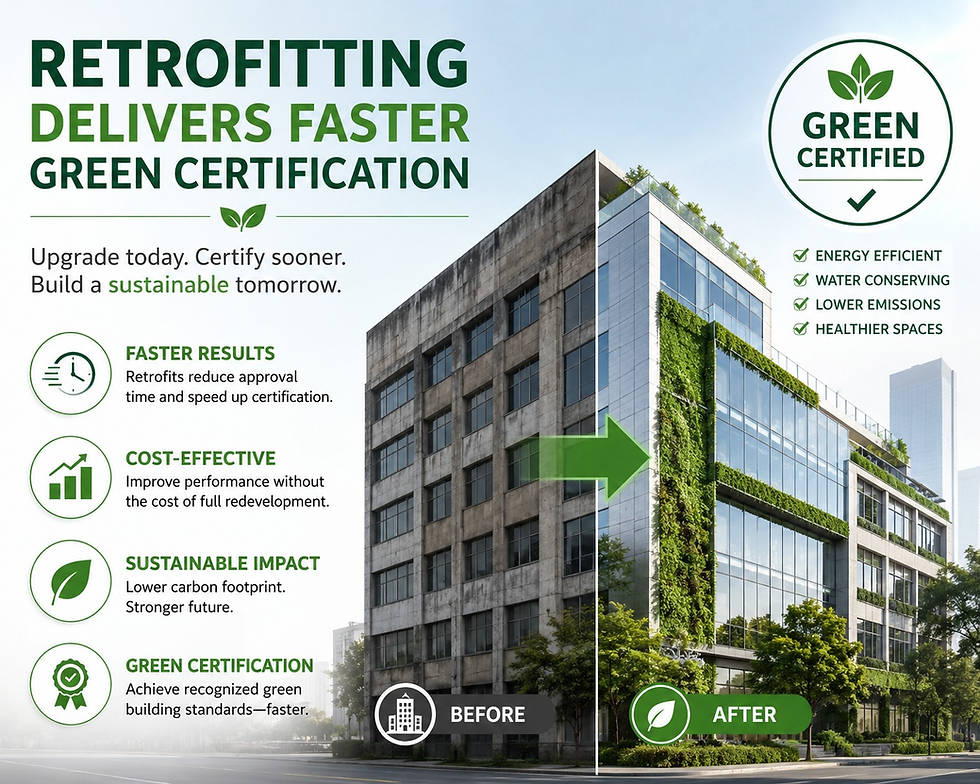
Retrofitting Delivers Faster Green Certification
Green building certification systems such as IGBC Existing Buildings, LEED, and GRIHA recognize operational efficiency improvements, not just new construction. This means existing commercial buildings can qualify for certification by upgrading water efficiency, energy performance, waste management, indoor environmental quality, and maintenance practices.An IGBC Existing Building Certification demonstrates that an operational property meets recognized sustainability standards without requiring complete redevelopment. This certification also enhances marketability, strengthens ESG reporting, and improves tenant confidence.
Water Efficiency Is Often the Highest ROI Upgrade
Among all retrofit opportunities, water conservation consistently delivers one of the fastest returns on investment. Commercial buildings consume enormous amounts of water every day through toilets, urinals, faucets, cooling systems, landscaping, and housekeeping activities.Many older buildings still operate with conventional plumbing fixtures that waste thousands of liters of potable water every month. Replacing these fixtures with efficient alternatives immediately reduces water consumption, sewage generation, and operating expenses.Water-saving retrofits also reduce dependency on municipal supply and water tankers, making buildings more resilient during periods of water scarcity.
Waterless Urinals Offer Exceptional Retrofit ROI
One of the simplest yet most impactful retrofit upgrades are replacing conventional flushing urinals with modern waterless urinals. Unlike traditional systems that require flushing after every use, waterless urinals eliminate continuous water consumption while maintaining hygiene through advanced mechanical valve technology. They also reduce plumbing maintenance, eliminate flush valve failures, and significantly lower wastewater generation. Solutions like Zerodor Waterless Urinals provide an effective retrofit option because they require minimal plumbing modifications while delivering substantial long-term savings. Each installed unit can save more than 150,000 liters of water annually, helping commercial properties reduce utility costs while earning valuable green building credits.

This type of water fixture retrofit ROI is often achieved much faster than many energy-efficiency projects because the reduction in water bills begins immediately after installation.
Brownfield Sustainability Upgrades Maximize Existing Assets. A brownfield sustainability upgrade focuses on improving existing commercial infrastructure instead of abandoning valuable built assets. Rather than viewing older buildings as inefficient, modern retrofit strategies transform them into resource-efficient properties through targeted improvements such as:
Water-efficient plumbing fixtures
Waterless urinals
Rainwater harvesting systems
Smart water monitoring
LED lighting upgrades
HVAC optimization
Building automation systems
Waste segregation and recycling infrastructure
Renewable energy integration
These improvements collectively increase building performance while preserving existing investments.
Retrofitting Supports ESG and Corporate Sustainability Goals
Environmental, Social, and Governance (ESG) reporting has become a strategic priority for businesses occupying commercial spaces. Corporate tenants increasingly evaluate buildings based on sustainability performance before signing leases. Retrofitted green buildings provide measurable environmental improvements, including reduced water consumption, lower carbon emissions, decreased waste generation, and improved operational efficiency. These measurable outcomes strengthen ESG disclosures while helping organizations achieve sustainability commitments. Property owners who invest in retrofit projects are also better positioned to attract environmentally conscious tenants seeking resource-efficient workplaces.
Lower Operating Costs Create Long-Term Financial Value
Utility expenses continue to rise across India's commercial real estate sector. Every unnecessary liter of water consumed, and every inefficient building system directly impacts operating budgets. Retrofitting reduces recurring expenses instead of merely shifting them into future maintenance cycles. Water-efficient fixtures, optimized plumbing systems, efficient lighting, and smart building controls continue generating savings year after year. The cumulative financial impact often exceeds the initial retrofit investment, making sustainability upgrades a sound business decision rather than simply an environmental initiative.

Green Buildings Increase Property Value
Commercial buildings with recognized sustainability certifications generally enjoy stronger market positioning. Certified properties often experience higher occupancy rates, increased tenant retention, and improved investor confidence. As sustainability becomes an important leasing criterion, buildings with efficient infrastructure gain a competitive advantage over conventional properties. Retrofitting enables existing assets to remain competitive without requiring expensive redevelopment. For aging commercial buildings, sustainability upgrades effectively extend asset life while improving long-term valuation.
Choosing High-Impact Retrofit Priorities
Successful retrofit projects begin by identifying upgrades that deliver the greatest operational impact. Water conservation measures frequently provide the quickest measurable results because they reduce both water consumption and wastewater treatment requirements. Facility managers should prioritize improvements that generate immediate savings while supporting long-term sustainability objectives. Water-efficient fixtures, leak detection, waterless sanitation systems, and monitoring technologies often produce visible improvements within the first year. When combined with energy and waste management initiatives, these upgrades create a comprehensive pathway toward green certification.
Retrofitting Is the Practical Future of Sustainable Commercial Buildings
India already has millions of square meters of operational commercial real estate. Replacing these buildings is neither economically practical nor environmentally responsible. Improving them is a smarter solution. Retrofitting allows commercial properties to reduce operating costs, conserve valuable water resources, strengthen ESG performance, and qualify for IGBC Existing Building Certification without the enormous expense of rebuilding. Strategic upgrades, particularly water-efficient solutions like Zerodor Waterless Urinals, demonstrate that even small infrastructure improvements can deliver substantial environmental and financial returns. For organizations seeking a cost-effective path toward sustainability, retrofitting is no longer an alternative to new construction; it is increasingly becoming the preferred strategy for building a greener, more resilient future.


Comments