
Your Building Is Wasting Lakhs of Litres of Water Every Year — And Vastu Shastra Warned Us About This First

Why every flush in your urinal is both a water crisis and a Vastu dosh — and what forward-thinking builders, facility managers, and property developers are doing about it
India is running out of water. This is not a future problem. It is happening right now, in the cities where your offices stand, in the malls your customers visit, in the government buildings your employees walk through every day.
54% of India faces high to extremely high water stress. Per capita water availability has dropped from 1,820 cubic metres in 2001 to under 1,545 cubic metres today — and is projected to fall further to 1,191 cubic metres by 2050. The country is on track to become water-scarce within a generation.
And one of the biggest, most overlooked contributors to this crisis is hiding in plain sight inside every commercial restroom in the country: the conventional flushing urinal.
A single traditional urinal flushes 1 to 4 litres of clean, treated water per use. In a commercial building with moderate footfall, that adds up to 50,000 to 1,50,000 litres of water wasted per urinal — every single year. Across a mall with 20 urinals, that is 30 lakh litres annually. Across a corporate campus with 50 urinals, it is 75 lakh litres. Across India's hundreds of thousands of offices, colleges, hospitals, and government buildings — the number is staggering.
We cannot keep flushing away water we do not have. Every drop saved matters. Every building that chooses not to waste water is part of the solution.
But here is what makes this story remarkable: this is not just a modern environmental concern. Ancient India already knew this. Vastu Shastra warned us about it thousands of years ago — in a language that speaks not of litres and cubic metres, but of Prana, Panchamahabhutas, and energy balance.
What Vastu Shastra says — and why it still matters in 2026
Vastu Shastra is the ancient Indian science of spatial design, rooted in Vedic texts and built on the Panchamahabhutas — the five essential elements of Earth (Prithvi), Water (Jal), Fire (Agni), Air (Vayu), and Space (Akash). Every room in a building, according to Vastu, either supports or disrupts the balanced flow of these elements.
The bathroom and toilet, Vastu is clear, are the most energetically sensitive spaces in any structure. They are spaces of elimination — and if not designed, maintained, and managed correctly, they become active generators of Vastu dosh: energy imbalances that silently affect the health, prosperity, and harmony of everyone who lives or works in the building.
For builders and developers, this matters because today's buyers — whether residential homebuyers or commercial property tenants — are asking about Vastu compliance at the specification stage. Green building certifications, Vastu compliance, and water efficiency are no longer separate conversations. They are converging.
Vastu's core principles about bathrooms align precisely with what modern water conservation science recommends. Here is what the ancient texts prescribe:
1. Stagnant water creates negative energy and invites illness
In Vastu, water (Jal) is associated with wealth, purity, and the natural flow of positive energy. But water that becomes stagnant — sitting still, mixed with waste, not flowing — is considered energetically "dead" and actively harmful. Stagnant water energy is believed to attract negativity and illness.
This is exactly what a conventional urinal creates. After every flush, water sits in the wet trap, mixes with uric sediment, and becomes a breeding environment for ammonia-producing bacteria. The drain line stays permanently moist. Water that was meant to flow becomes water that festers.
Wasting water is bad enough. Wasting water and then allowing it to stagnate in drain lines — contributing to both resource depletion and energy disruption — is a double problem that no building should accept in 2026.
2. Foul odour disrupts Prana — the life force of your building
Vastu Shastra is unambiguous: foul smells block the flow of Prana, the life-force energy that must circulate freely through every space in a building. Bad odours and stagnant air worsen Vastu dosh and are explicitly linked in Vastu texts to health disturbances, reduced productivity, and declining prosperity.
This is not a metaphor. It is chemistry. When urine reacts with flush water, the enzyme urease breaks down urea into ammonia (NH₃) — the colourless, pungent gas your nose detects in every badly maintained restroom. Ammonia is released specifically because water was added. Without water, urine drains cleanly and produces no detectable odour.
Every flush that wastes 2 to 4 litres of water is also producing the ammonia that disrupts Prana flow. The two problems are inseparable. Save the water — and the odour disappears with it.
3. Dampness is an active Vastu dosh
Every time a conventional urinal is flushed, it introduces moisture into the pan, the drain line, the surrounding tiles, and the air. Chronic bathroom dampness — visible as discoloured grout, persistent wall stains, lingering smell even after cleaning — is in Vastu terms a living, active dosh. Poor ventilation in bathrooms not only traps humidity but also locks in negative energy.
For property developers and facility managers, this dampness also has a direct maintenance cost. Wet surfaces promote bacterial growth, accelerate tile and grout degradation, require more frequent professional cleaning, and shorten the lifespan of plumbing fittings. The Vastu dosh and the facility management problem are the same problem.
4. The Air element (Vayu) must remain clean and free
Air (Vayu) represents movement, freshness, and the free circulation of prana. The northwest zone of any structure is governed by Vayu. When a bathroom in or near this zone is perpetually damp and ammonia-laden, the Air element itself is compromised — affecting the energy of the entire building, not just the restroom.
For commercial buildings — offices, banks, hospitals, educational institutions, government buildings — where hundreds or thousands of people pass through daily, the energetic quality of the Air element is not trivial. A restroom that smells is not just a facility management failure. In Vastu terms, it is actively degrading the energy environment of every space connected to it.
5. Bathroom energy affects the prosperity of the entire building
This is perhaps Vastu's most striking claim — and one that resonates strongly with commercial real estate stakeholders. Toilets and bathrooms, when positioned incorrectly or maintained poorly, can disturb the overall energy balance, potentially leading to financial troubles, health issues, and disharmony in relationships.
For a builder or developer, the implication is direct: a building designed with Vastu-compliant bathrooms — dry, odour-free, with clean air circulation — is a building that supports the prosperity and well-being of its occupants. And a building whose restrooms are perpetually wet, smelly, and high-maintenance is working against its own energy field.
The water crisis and Vastu dosh are the same crisis
This is what makes the Zerodor story uniquely Indian. No other country has a civilisational tradition that warned, thousands of years ago, against wasting water and allowing it to stagnate in waste lines. Vastu Shastra encoded water wisdom into architectural principles long before modern environmental science gave us the data to quantify it.
The conventional flushing urinal violates both. It wastes clean drinking water — a resource India cannot afford to lose — and it creates exactly the energetic conditions Vastu identifies as harmful: stagnant water, foul odour, persistent dampness, and compromised air quality.
Saving water is not just an environmental obligation. It is, according to ancient Indian wisdom, a prerequisite for a harmonious, prosperous building.
How Zerodor solves both problems — for every building type
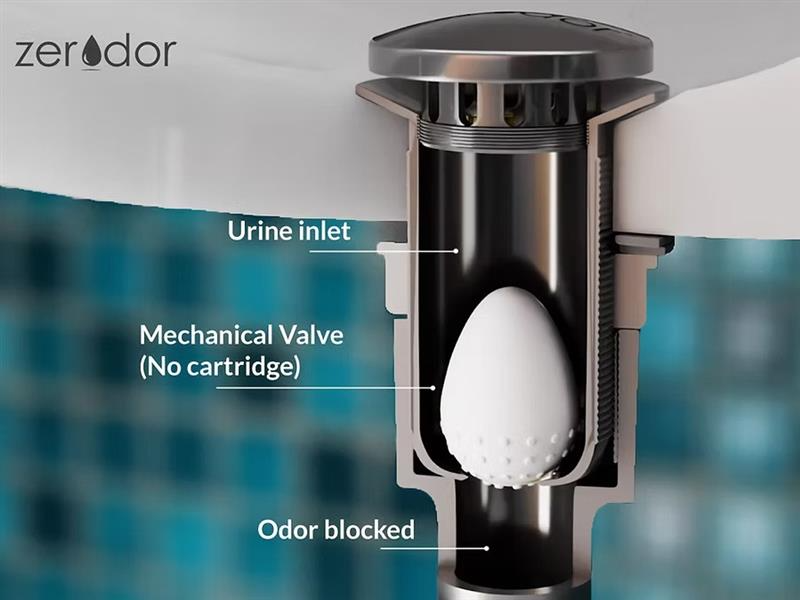
Zerodor is India's first patented, GreenPro-certified waterless urinal technology, developed from research at IIT Delhi. It replaces the waste coupling in any existing conventional urinal pan with a mechanical ball valve assembly — no new fixtures, no civil work, no plumber required. Installation takes under 15 minutes per urinal.
The ball valve floats open when urine enters, allows clean drainage, and settles back to physically seal the drain when flow stops. No water. No cartridge. No chemical sealant. No odour. No wasted water.
Here is how Zerodor applies across the building types where water waste is largest:
Corporate offices and IT parks: A 10-storey office with 30 urinals operating at moderate footfall wastes approximately 45 lakh litres per year. Zerodor brings that to zero, supports LEED and IGBC green building points, reduces STP load, and delivers measurable ROI within 12–18 months — directly relevant to the sustainability mandates now included in most large corporate lease specifications.
Shopping malls: High-footfall commercial spaces are among the biggest restroom water consumers in India. A large mall with 60 urinals across multiple floors can save over 90 lakh litres annually with Zerodor. This reduces water purchase costs, reduces sewage volumes, and contributes directly to the mall's green building rating and ESG reporting.
Banks and financial institutions: Financial institutions are increasingly subject to BRSR (Business Responsibility and Sustainability Reporting) requirements from SEBI. Water conservation metrics — including restroom water savings — are quantifiable, verifiable, and reportable. Zerodor provides a documented, certified, and measurable water saving figure for every installation.
Government buildings: Zerodor is a natural fit for GRIHA certification requirements, which are mandatory for many government-funded projects under CPWD and PWD specifications. Indian Railways has already deployed Zerodor across multiple stations. Government offices, public sector facilities, and institutions under smart city programmes benefit from both the water saving and the certification point contribution.
Educational institutions — colleges and schools: Water conservation in educational campuses serves double purpose: it reduces operational costs for institutions often running on tight budgets, and it creates a visible, real-world model of sustainable practice for students. Given the Swachh Bharat Abhiyan's focus on institutional sanitation, waterless urinals in colleges represent a direct alignment with national policy.
Hospitals and healthcare facilities: Wet surfaces in hospital restrooms are infection risks. Zerodor eliminates the flush water that keeps restroom surfaces and drain lines perpetually moist — reducing the microenvironment in which pathogens thrive. This is both a hygiene improvement and, in Vastu's framework, a reduction in the damp-linked energy dosh that affects the healing environment of healthcare spaces.
Real estate developers and builders: For builders developing residential complexes, commercial properties, or mixed-use projects, Zerodor is a specification-stage decision that adds measurable value. IGBC-rated green residential projects grew 31% year-on-year in India. Buyers and tenants are increasingly asking about water efficiency, sustainable fixtures, and green certifications. Pre-installing Zerodor in common-area restrooms adds a verifiable water-saving claim to the project's green credentials — and it aligns the project with Vastu principles around bathroom energy, which remains a significant purchase consideration for Indian homebuyers.
The Vastu remedy that goes to the source
Vastu experts recommend several remedies for bathroom dosh: sea salt bowls to absorb negative energy, camphor burning to purify the air, essential oil diffusers to counteract odour. These are valuable as supportive practices.
But every one of these remedies works around the problem. They address the symptom — negative energy, bad odour, heavy vibrations — not the cause.
The cause is the flush. The water reacts with urine. The ammonia rising from the drain. The chronic dampness of a perpetually wet system.
Zerodor addresses the cause. No flush urinals means no ammonia reaction. No water means no dampness. A sealed drain means no sewer gas. The Vastu dosh is not masked — it is structurally eliminated.
A Vastu-compliant restroom should be dry, clean, odour-free, and energetically light. That is not a poetic aspiration. It is an engineering specification. And Zerodor is what fulfills it.
In summary: what this means for your building
Problem | What conventional urinals create | What Zerodor delivers |
Water waste | 50,000–1,50,000 litres/urinal/year | Zero litres |
Vastu dosh (stagnant water) | Permanent wet drain line | Dry, sealed drain |
Vastu dosh (odour / Prana disruption) | Ammonia from urine-water reaction | No reaction, no odour |
Vastu dosh (dampness) | Chronic moisture from every flush | Zero moisture introduced |
Vastu dosh (Air element) | Ammonia contaminating Vayu | Clean air, free Prana |
Green building certification | No contribution | LEED, IGBC, GRIHA, GreenPro points |
Maintenance cost | Frequent cleaning, plumbing calls | Reduced maintenance |
ESG / BRSR reporting | No quantifiable water metric | Documented, verified water savings |
Frequently asked questions
Q.1. Does Vastu Shastra specifically prescribe waterless urinals?
Ans. Vastu texts predate modern plumbing and do not reference specific technologies. However, the energetic principles Vastu prescribes for bathrooms — eliminate stagnant water, prevent foul odour, keep spaces dry, protect the Vayu element — are precisely the outcomes that waterless technology delivers. The alignment is with the principle, which is what matters.
Q.2. Can Zerodor fix a bathroom that is in a structurally wrong Vastu direction?
Ans. Zerodor cannot change where a bathroom sits in a building's layout. For directional Vastu dosh, a qualified Vastu consultant should be engaged. What Zerodor does is reduce the intensity of the bathroom's negative energy output — regardless of direction — by eliminating the three primary sources of bathroom dosh: odour, dampness, and stagnant drain water.
Q.3. Is Zerodor suitable for large commercial installations?
Ans. Yes. Zerodor has been deployed across 700+ organisations including Indian Railways, corporate campuses, airports, hospitals, banks, and educational institutions. It is designed specifically for high-footfall Indian conditions. The company provides a site survey, installation support, and a pan-India after-sales service network.
Q.4. How does Zerodor contribute to green building ratings?
Ans. Zerodor is India's first GreenPro Certified waterless urinal (CII-IGBC). It contributes water efficiency credits toward LEED, IGBC, and GRIHA certifications. The exact credit allocation depends on your project's rating system and scope — contact us for a project-specific assessment.
Q.5. What is the ROI for a builder or facility manager?
Ans. The ROI depends on water tariff, footfall, and number of urinals. A typical corporate installation recovers the Zerodor investment within 12 to 24 months through direct water bill savings alone, before accounting for reduced STP operational costs, lower sewage charges, and reduced maintenance expenditure.
Ready to make your building Vastu-aligned, water-efficient, and green-certified?
Zerodor by Ekam Eco Solutions — India's first patented, IIT Delhi-developed, GreenPro-certified waterless urinal technology. Deployed across 700+ organisations nationwide.
Comments