
Sustainable Odor Management Solutions for High-Footfall Buildings
- bhumikat1
- Feb 19
- 2 min read
In high-footfall buildings airports, malls, office complexes, hospitals, stadiums, and transit hubs , odor management is a daily battle. Thousands of users, continuous activity, and limited cleaning windows make traditional solutions feel like short-term fixes rather than long-term answers. Masking smells with chemicals may work for a few hours, but it doesn’t address the real problem.
True odor management in busy buildings starts with understanding the source. Odors are typically caused by stagnant water, urine residue, high moisture levels, and sewer gas backflow. In high-traffic washrooms, these factors multiply rapidly, making conventional flushing systems inefficient and resource-heavy.
Why Chemicals Fail in High-Footfall Spaces
Chemical air fresheners and strong cleaners only suppress odors temporarily. Over time, they degrade indoor air quality, increase maintenance costs, and expose users and cleaning staff to harmful residues. In buildings that operate almost 24/7, relying on chemicals becomes both expensive and unsustainable.
Sustainable odor control focuses on prevention rather than repeated treatment. When odors are stopped at the source, washrooms stay fresher for longer , without constant intervention.
Eliminating Water Stagnation: The Game Changer
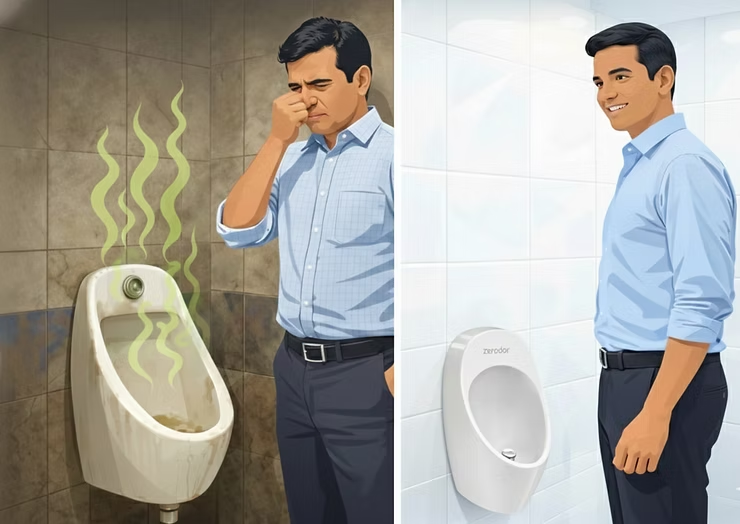
One of the biggest contributors to persistent odor is water stagnation in traditional urinals. Constant flushing creates damp conditions where bacteria thrive, especially in high-use environments. The more the usage, the more water enters the system , and the stronger the odor becomes. Waterless urinals like Zerodor eliminate this issue entirely. With no flushing and no standing water, bacteria have fewer opportunities to grow. Odors are prevented before they start, not masked after they appear.
Smart Design for Continuous Use
High-footfall buildings require sanitation systems that perform consistently, even during peak hours. Zerodor’s odor-trap technology blocks sewer gases while allowing waste to pass smoothly, ensuring reliable odor control regardless of usage frequency.
With fewer moving parts and no dependence on water, maintenance needs are reduced. This makes waterless systems especially suitable for busy facilities where downtime is costly and cleanliness expectations are high.
Better Airflow, Healthier Spaces
Effective ventilation plays a vital role in sustainable odor management. When combined with odor-source control, airflow removes moisture and keeps washrooms feeling fresh naturally. Since Zerodor minimizes odor release at the fixture level, ventilation systems work more efficiently without the need for artificial fragrances.
The result is improved indoor air quality , an important factor in public health, employee comfort, and overall user experience.
Reducing Load on Infrastructure
In high-footfall buildings, every flush adds to wastewater volume and increases pressure on sewage treatment plants. Zerodor reduces STP load by eliminating flushing altogether. Less wastewater means lower energy consumption, reduced operational costs, and more efficient infrastructure management. Sustainability, in this context, goes beyond water savings - it extends to protecting urban sanitation systems.
The Future of Odor Management
As buildings become smarter and sustainability-driven, odor management must evolve too. The future lies in solutions that combine intelligent design, water efficiency, and long-term reliability.

By adopting waterless sanitation systems like Zerodor, high-footfall buildings can achieve consistent odor control, lower environmental impact, and better operational efficiency , without relying on chemicals. Because sustainable buildings don’t just manage odors. They prevent them.


Comments