
How Zerodor Helps Achieve LEED, IGBC & GRIHA Points: A Complete Guide
- bhumikat1
- Apr 17
- 3 min read
Why Certifications Matter Today
Green certifications are no longer just a “nice-to-have” badge , they’re becoming a core business advantage for modern buildings. Developers, facility managers, and corporate occupiers are now treating sustainability as a measurable asset, not just a marketing claim.
1. Property Value
Certified green buildings consistently command higher market value. Why?
Lower operating costs (water, energy, maintenance)
Better long-term asset performance
Higher demand from ESG-focused investors
A building that demonstrates measurable resource efficiency is seen as future-ready, reducing risk and increasing resale or rental value.
2. Tenant Preference
Today’s tenants, especially corporates and MNCs - are actively choosing spaces that align with their sustainability goals.
ESG reporting requirements are pushing companies to occupy green-certified buildings
Healthier indoor environments improve employee well-being
Sustainability commitments enhance brand perception
In many cases, tenants are even willing to pay a premium for spaces that help them meet their environmental targets.
3. Regulatory Compliance
Governments and urban authorities are tightening environmental norms, especially around water and energy usage.
Building codes are evolving toward mandatory efficiency benchmarks
Water conservation is becoming critical in water-stressed regions
Non-compliance can lead to penalties or operational restrictions
Green certifications help buildings stay ahead of these regulations, reducing future compliance risks.
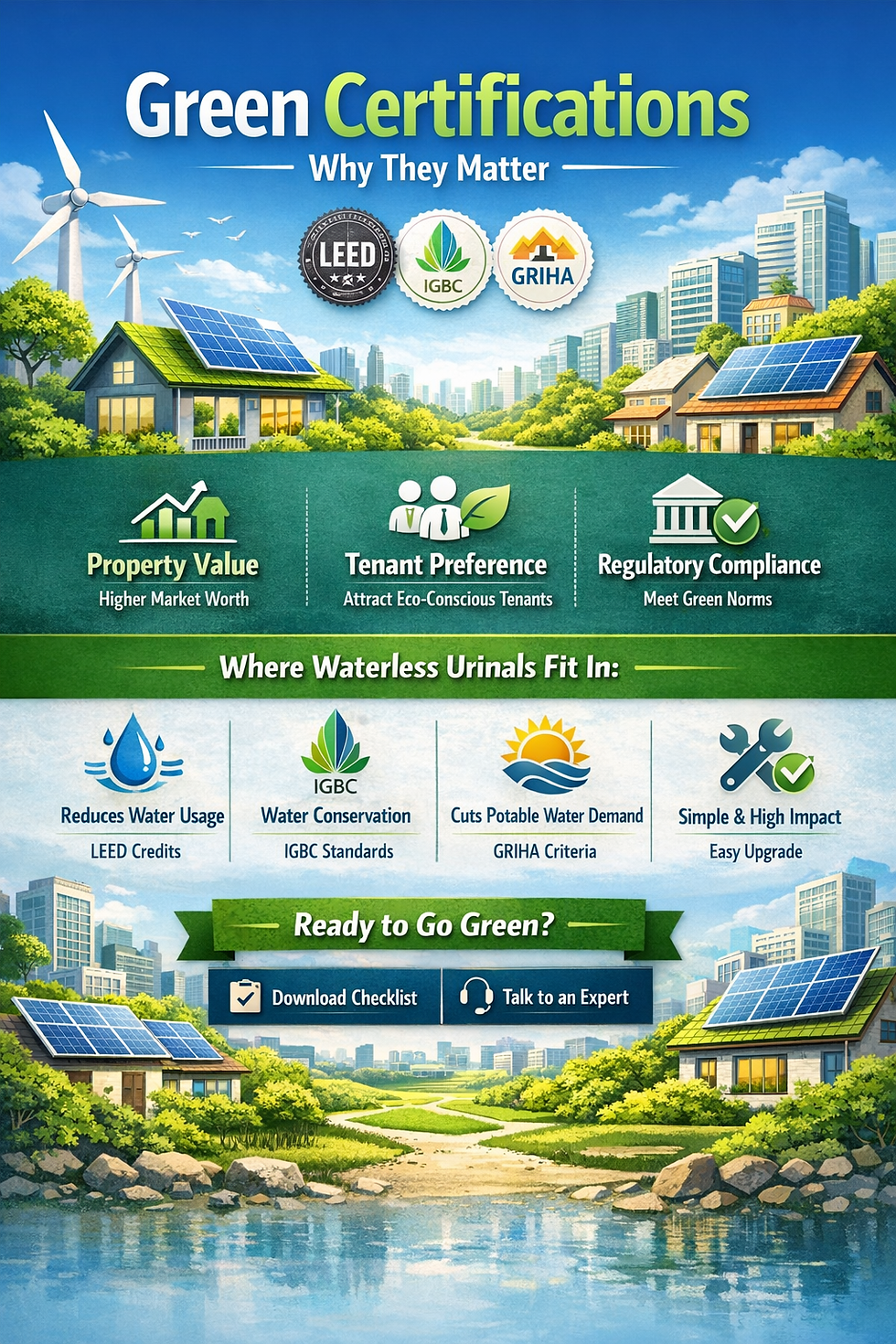
Where Waterless Urinals Fit In
Water efficiency is one of the highest-weighted categories in most green building rating systems ,and for good reason. Water scarcity is a growing challenge, particularly in countries like India.
How Zerodor Adds Value
Zerodor waterless urinals directly contribute to Water Efficiency credits, making them a high-impact, low-effort upgrade.
1. Significant Water Savings
Each traditional urinal can use up to 150,000+ liters of water annually. Eliminating this usage creates immediate, measurable savings.
2. Improved Certification Scores
By reducing potable water consumption, Zerodor helps projects:
Earn more points in water efficiency categories
Improve overall certification ratings
Strengthen sustainability documentation
3. No Dependency on Chemicals or Cartridges
Unlike many alternatives, Zerodor’s technology avoids recurring consumables, making it:
More cost-effective over time
Easier to maintain
More sustainable across the lifecycle
4. Ideal for High-Footfall Spaces
Commercial buildings, malls, airports, and offices see the maximum impact, where water savings scale rapidly with usage.
The Bigger Picture
Waterless urinals aren’t just a fixture upgrade , they’re a strategic sustainability intervention.
They help buildings:
Reduce operational costs
Strengthen ESG positioning
Achieve higher green certification ratings
And in a market where sustainability is directly tied to financial and reputational performance, that’s a competitive edge that’s hard to ignore.
LEED
Waterless urinals play a direct and measurable role in achieving LEED certification goals. By eliminating the need for flushing, they significantly reduce indoor water consumption, which is a key parameter under LEED’s Water Efficiency category. This reduction helps projects earn valuable Water Use Reduction credits , one of the most impactful scoring areas. Since LEED prioritizes quantifiable performance improvements, installing waterless urinals like Zerodor provides a clear, data-backed way to strengthen a building’s certification score while lowering operational costs.
IGBC
For projects targeting IGBC certification, waterless urinals contribute directly to water conservation benchmarks that are critical in the Indian context. IGBC places strong emphasis on reducing dependency on potable water, especially in high-density and water-stressed regions. By integrating Zerodor systems, buildings can demonstrate substantial water savings, which helps in achieving higher certification tiers such as Gold or Platinum. This not only enhances sustainability credentials but also increases the asset’s market appeal and long-term value.

GRIHA
Aligned with India’s national sustainability framework, GRIHA recognizes solutions that reduce overall environmental impact, particularly water usage. Waterless urinals support GRIHA’s focus on minimizing potable water demand by eliminating unnecessary consumption at the source. This makes them especially relevant for projects aiming to meet government-backed green building standards. By adopting such solutions, developers can ensure compliance while also contributing to broader environmental goals like water conservation and resource efficiency.

Practical Benefit
Unlike many sustainability upgrades that require complex infrastructure changes, switching to waterless urinals is a straightforward and highly effective intervention. It doesn’t involve major plumbing overhauls or ongoing system dependencies. Instead, it offers a simple implementation process, delivers measurable water savings from day one, and creates a high-impact improvement in both operational efficiency and sustainability performance. This makes it one of the most practical and scalable solutions for any commercial or institutional building.
If you're looking to improve your building’s sustainability performance without adding complexity, this is a smart place to start.
Download the checklist to evaluate your current water usage and identify quick wins
Talk to an expert to understand how Zerodor can help you achieve certification goals faster and more cost-effectively


Comments