
Waterless vs Traditional Urinals: 5-Year Analysis
- bhumikat1
- Apr 21
- 3 min read
The Myth of “Lower Initial Cost”
At first glance, traditional urinals appear to be the more economical choice. The upfront purchase and installation costs are typically lower, which makes them an easy default decision for many projects. But this is where most evaluations stop , and where the real cost story gets missed.
In reality, what looks cheaper initially often becomes more expensive over time. Traditional systems are built on continuous resource consumption, meaning the moment they are installed, they begin generating recurring expenses. The true cost isn’t what you pay on day one, it’s what you keep paying every single day after.
Cost Breakdown
Traditional Systems
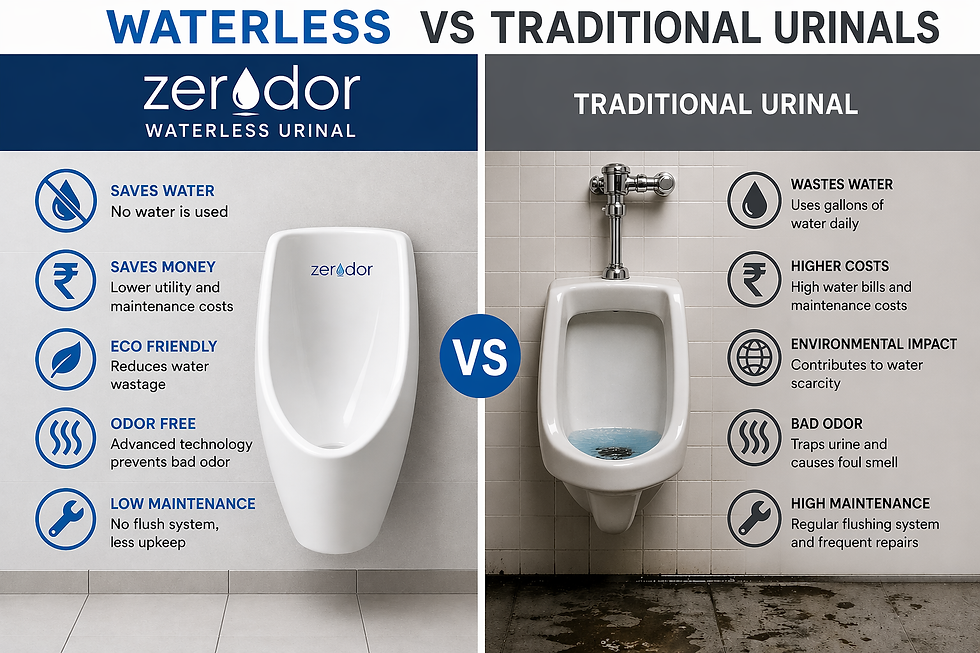
Traditional urinals come with a series of ongoing costs that are often underestimated during planning. The most significant is continuous water usage. Every flush consumes water, and in high-footfall environments, this adds up to thousands of liters daily , translating into a substantial monthly utility expense. Then comes plumbing wear and tear. Constant water flow increases the likelihood of leaks, blockages, and component failures, leading to frequent repairs and maintenance interventions.
There’s also the cost of chemical cleaning and odor control. Because traditional systems rely on water but don’t eliminate odor at the source, facilities often compensate with cleaning agents, fresheners, and additional housekeeping efforts. Over time, these costs quietly accumulate. In short, traditional systems are not just fixtures , they are ongoing cost centers.
Waterless Systems
Waterless urinals flip this equation entirely by removing the primary source of recurring cost: water.
With no flushing required, water consumption drops to zero for that fixture, immediately eliminating one of the largest operational expenses.
Maintenance is also significantly simplified. With fewer moving parts and no continuous water flow, maintenance requirements are minimal, reducing both service frequency and associated costs.
Additionally, modern waterless systems are designed for stable, consistent performance, often eliminating the need for excessive chemical usage or odor management interventions.
Instead of generating recurring expenses, they create predictable, controlled operating conditions.
The 5-Year Reality
When you look at the total cost over a 5-year period, the difference becomes impossible to ignore.
Traditional systems continue to accumulate expenses - water bills, repairs, cleaning chemicals, and labor - year after year. What started as a “cheaper” option quickly turns into a long-term financial drain.
Waterless systems, on the other hand, stabilize costs early. After the initial investment, ongoing expenses remain low and predictable, allowing businesses to break free from continuous spending cycles.
Over time: Traditional systems become increasingly expensive whereas Waterless systems become increasingly efficient
ROI Window
One of the most compelling aspects of switching to waterless urinals is the speed of return on investment. Because the savings , especially on water , start immediately, most businesses are able to recover their initial investment within 6 to 12 months. This is a rare advantage. Unlike many infrastructure upgrades that take years to justify their cost, waterless systems begin paying back almost instantly.

Cost Breakdown
Zerodor vs Traditional Urinal
Cost Factor | Zerodor (Waterless) | Traditional Urinal |
Water Usage | 0 liters | 1–4L per use |
Monthly Water Bill | ₹0 | High recurring |
Installation Cost | Low–Medium | High |
Plumbing Required | Minimal | Extensive |
Maintenance | Low | High |
Electricity Needed | No | Yes (sensor systems) |
Recurring Consumables | None | Chemicals + parts |
ROI Time | Fast (~6 months) | Slow |
After ROI: Pure Savings
Once the initial investment is recovered, the equation shifts completely.
There are no major recurring costs to offset, which means every month going forward translates into direct savings. Reduced utility bills, lower maintenance, and minimal consumables all contribute to a steady improvement in operational efficiency.
At this stage, the system is no longer just cost-neutral , it becomes a profit-driving decision.
If you’re still evaluating based on upfront cost alone, you’re only seeing part of the picture.
Use the ROI calculator to understand your real savings potential
Discover how quickly a simple switch can turn into long-term financial gain


Comments