
Waterless Urinals for Railways & Airports: A Solution For High-Traffic
- bhumikat1
- Apr 28
- 3 min read
The High-Traffic Challenge
Railways and airports are among the most demanding public infrastructure environments. Unlike commercial buildings with predictable usage patterns, these spaces operate almost non-stop, handling thousands, sometimes millions , of users every day. This creates a unique operational challenge. Restrooms in such facilities must handle massive usage volumes, often far beyond their original design capacity. As a result, maintenance teams are under constant pressure to keep facilities functional and hygienic at all times.
At the same time, these environments face high maintenance costs. Continuous usage leads to faster wear and tear, more frequent repairs, and increased staffing requirements. Add to this the constant demand for water, and the operational burden becomes even heavier, especially in regions where water scarcity is already a concern.

Why Traditional Systems Fail
Traditional urinal systems struggle to perform effectively under these conditions. One of the biggest issues is frequent breakdowns. Continuous flushing, combined with heavy usage, puts immense strain on plumbing systems. Pipes clog, valves fail, and leaks become common , leading to downtime and user dissatisfaction.Another major limitation is water dependency. Every use requires flushing, which means water consumption scales directly with footfall.
In high-traffic areas, this results in enormous daily water usage, significantly increasing operational costs and environmental impact.Hygiene is also a challenge. Despite regular cleaning, inconsistent hygiene levels can occur due to high usage frequency. Splashback, water stagnation, and odor buildup make it difficult to maintain a consistently clean and pleasant environment. In short, traditional systems are not designed for the intensity and scale of modern public infrastructure.

Why Waterless Works
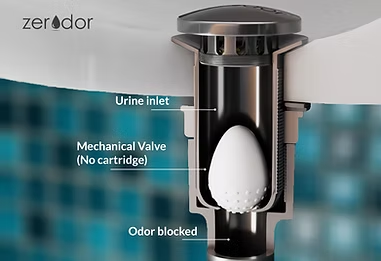
Waterless urinals offer a fundamentally different approach , one that is better suited to high-traffic environments. First, they eliminate flushing dependency entirely. Without the need for water, one of the biggest operational constraints is removed. This not only reduces resource consumption but also ensures that the system continues to function even in situations where water supply is inconsistent.
Second, they lead to lower downtime. With fewer mechanical components and no reliance on flushing systems, the chances of breakdown are significantly reduced. This means fewer repairs, less disruption, and more reliable performance in high-demand settings. Most importantly, waterless urinals are a scalable solution. Whether installed in a single station or across an entire airport network, their benefits multiply with usage. The higher the footfall, the greater the water savings and operational efficiency.
Impact at Scale
When implemented across large public infrastructure networks like railways and airports, the impact becomes transformative. The most immediate benefit is water conservation. With thousands of daily users, even a single location can save millions of liters of water annually. Multiply this across multiple stations or terminals, and the numbers become staggering.
Operationally, there is a significant reduction in maintenance burden. Fewer breakdowns mean less emergency repair work, lower maintenance costs, and more efficient use of manpower. Facility teams can shift from reactive problem-solving to proactive management.
Additionally, improved reliability and hygiene contribute to a better user experience , an increasingly important factor in public infrastructure perception and rankings.
The Bigger Opportunity
For railways and airports, adopting waterless urinals is not just about saving water , it’s about redefining operational efficiency at scale.
It’s a shift from:
Resource-heavy systems → resource-efficient solutions
Reactive maintenance → predictable operations
Rising costs → controlled, optimized spending
And in high-traffic environments, even small per-use savings translate into massive long-term impact.
If you’re managing or upgrading high-footfall infrastructure, the best way to evaluate impact is to see it in action.
Compare Zerodor waterless urinals with traditional urinals in your facility and measure real-world savings, performance, and maintenance benefits


Comments