
Waterless Urinals ROI Calculator: How Much Can Your Business Save?
- bhumikat1
- Apr 16
- 5 min read
Introduction: The Hidden Cost of Every Flush
Every time a urinal is flushed, 2–4 liters of treated drinking water is simply washed away. This isn’t raw water ,it’s water that has already gone through purification, pumping, storage, and distribution. In other words, you’re not just flushing water—you’re flushing energy, infrastructure cost, and a valuable resource that many regions struggle to secure daily.
Now scale that seemingly small act.
In a commercial space ,offices, malls, airports, factories ,urinals are used hundreds, sometimes thousands of times a day. Multiply that by multiple units across floors, and then stretch it over 365 days a year. What appears to be a negligible operational expense quietly compounds into a massive, recurring cost. Over time, this adds up to lakhs of rupees spent purely on flushing, something that adds zero value to your core business operations. But the real issue goes beyond cost. In a country like India, where water stress is no longer a distant concern but an immediate reality, this level of consumption is not just inefficient it’s risky. Cities are already facing groundwater depletion, rising water tariffs, and increasing dependency on tankers. For businesses, this translates into unpredictable costs, operational disruptions, and growing ESG (Environmental, Social, Governance) pressure from stakeholders.

This is where the conversation needs to shift , from cost to strategy. Waterless urinals eliminate the need for flushing altogether, cutting down water usage at the source. But the real game-changer is when this shift is backed by a clear ROI calculation. When businesses can actually see how much water they save, how much money they recover, and how quickly the investment pays back, the decision stops being “sustainable vs expensive” and becomes “smart vs outdated.” Because in today’s landscape, sustainability isn’t just about doing the right thing , it’s about making better business decisions.
What Is a Waterless Urinal System?
A waterless urinal is engineered to operate without the need for flushing water, relying instead on advanced odor-control mechanisms and bio-enzymatic solutions. Rather than using water as a medium to carry waste away, these systems are designed to manage hygiene and odor directly at the source , making them both efficient and environmentally responsible. Unlike traditional urinals, there is no continuous flow of water running through the system. This immediately eliminates one of the biggest sources of daily water wastage in commercial and public restrooms. Over time, this reduction has a significant impact not just on water bills, but also on overall resource consumption.
Another key difference is the absence of flush valves. Without these mechanical components, there’s less wear and tear, fewer chances of leakage or malfunction, and reduced maintenance requirements. This simplifies operations, especially in high-traffic facilities where conventional systems often face frequent breakdowns. Additionally, removing the need for constant water flow reduces unnecessary stress on plumbing infrastructure. Pipes, joints, and drainage systems experience less pressure and corrosion, leading to longer system life and lower repair costs over time.
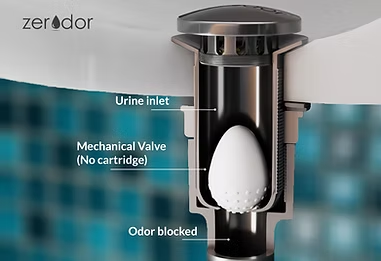
With solutions like Zerodor, the approach to odor control is fundamentally different. Instead of masking unpleasant smells with fragrances, it tackles the root cause using bio-enzymatic action. This ensures that odor is neutralized at the source itself, creating a cleaner, more hygienic environment that lasts longer - without relying on artificial or temporary fixes.
Why ROI Matters for Businesses
For decision-makers, sustainability alone isn’t enough. The question is:
“How much money will this save me?”
Waterless urinals directly impact:
Utility bills → Reduced water consumption
Maintenance costs → Fewer plumbing issues
Labor costs → Simplified cleaning routines
Chemical costs → Less dependency on harsh cleaners
This makes them not just a green upgrade, but a financial asset.
ROI Calculator: Estimate Your Savings
To simplify decision-making, an ROI calculator helps businesses quantify benefits instantly.
Inputs:
Number of urinals
Daily usage per urinal
Liters per flush
Cost of water per liter
Monthly maintenance cost
Outputs:
Annual water savings
Annual cost savings
ROI/payback period
Example: Real-World Savings
Let’s break it down:
A residential building with:
10 urinals
100 uses/day
3 liters/flush
Annual water usage:= 10 × 100 × 3 × 365= 10,95,000 liters/year
Even at ₹0.05 per liter: ₹54,750 saved annually (just water)
Now add:
Maintenance savings
Cleaning cost reduction
Total impact easily crosses ₹1–2 lakhs/year
Environmental Impact: Beyond Cost
The shift to waterless urinals isn’t just about reducing expenses, it’s about rethinking how resources are used in everyday operations. One of the most immediate benefits is the conservation of potable water. In conventional systems, drinking-quality water is used for flushing, which is a highly inefficient use of a scarce resource. By eliminating this need entirely, waterless urinals help preserve clean water for purposes where it’s actually required.
At the same time, they significantly reduce the load on sewage treatment plants. Every liter of water that goes down the drain needs to be treated, processed, and often recycled. When you cut down on flushing, you’re also reducing the volume of wastewater entering the system. This not only lowers treatment costs but also decreases the environmental burden on already strained infrastructure.
From a broader perspective, adopting waterless technology directly supports ESG and sustainability goals. Businesses today are under increasing pressure to demonstrate responsible resource management, reduce their environmental footprint, and align with green building standards. Water conservation is a measurable, high-impact metric, and waterless urinals provide a simple yet powerful way to contribute. This becomes especially critical for green-certified buildings aiming to maintain or improve ratings, as well as corporates operating under strict ESG mandates. For such organizations, sustainability is no longer optional it’s a performance indicator tied to reputation, compliance, and long-term growth.
Why Zerodor Stands Out
While many waterless urinal systems exist in the market, most rely heavily on cartridges for odor control. These cartridges need regular replacement, adding a hidden recurring cost that often offsets the initial savings from water reduction. Over time, this can make “waterless” solutions less economical than they initially appear.
Zerodor takes a fundamentally different approach. It eliminates the need for cartridges altogether, removing a major operational expense and simplifying maintenance. Instead, it uses bio-enzymatic odor control to break down odor-causing compounds at the source, ensuring long-lasting freshness without the need for frequent replacements.

Another key advantage is its compatibility with existing infrastructure. There’s no need for major plumbing changes or expensive retrofitting, which makes adoption quick and hassle-free. Businesses can transition without disrupting operations or investing heavily in new systems. The result is a solution that is not only sustainable but also practical. Lower operational costs, minimal maintenance, and ease of implementation combine to deliver a much faster return on investment , making it a smart upgrade rather than a complex overhaul.
If you’re looking to understand the real impact on your facility, the next step is simple. Start by calculating your potential savings , see how much water and money you could be saving annually by making the switch.


Comments